

Karlštejn Castle (Czech: hrad Karlštejn; German: Burg Karlstein) is a large Gothic castle founded 1348 by Charles IV, Holy Roman Emperor-elect and King of Bohemia. The castle served as a place for safekeeping the Imperial Regalia as well as the Bohemian/Czech crown jewels, holy relics, and other royal treasures. Located about 30 kilometres (19 mi) southwest of Prague above the village of the same name, it is one of the most famous and most frequently visited castles in the Czech Republic. A miniature replica of the castle was built by a Czech immigrant in Batchelor, Northern Territory. Founded in 1348, the construction works were directed by the later Karlštejn burgrave Vitus of Bítov, but there are no records of the builder himself. Some historians speculate that Matthias of Arras may be credited with being the architect, but he had already died by 1352. It is likely that there was not a progressive and cunning architect, but a brilliant civil engineer who dexterously and with a necessary mathematical accuracy solved technically exigent problems that issued from the emperor's ideas and requests. Instead, Holy Roman Emperor Charles IV personally supervised the construction works and interior decoration. Construction was finished nearly twenty years later in 1365 when the "heart" of the treasury – the Chapel of the Holy Cross situated in the Great tower – was consecrated. Following the outbreak of the Hussite Wars, the Imperial Regalia were evacuated in 1421 and brought via Hungary to Nuremberg. In 1422, during the siege of the castle, Hussite attackers used biological warfare when Prince Sigismund Korybut used catapults to throw dead (but not plague-infected) bodies and 2,000 carriage-loads of dung over the walls, apparently managing to spread infection among the defenders. Later, the Bohemian crown jewels were moved to the castle and were kept there for almost two centuries, with some short breaks. The castle underwent several reconstructions: in late Gothic style after 1480, in Renaissance style in the last quarter of the 16th century. In 1487, the big tower was damaged by fire and during the 16th century there were several adaptations. During the Thirty Years' War in 1619, the coronation jewels and the archive were brought to Prague, and in 1620, the castle was turned over to Ferdinand II, Holy Roman Emperor. After having been conquered in 1648 by Swedes, it fell in disrepair. Finally, a neo-Gothic reconstruction was carried out by Josef Mocker between 1887 and 1899, giving the castle its present look. The nearby village was founded during the construction of the castle and bore its name until it was renamed to Buda in the wake of the Hussite Wars. Renamed to Budňany in the 18th century, it was merged with Poučník and called Karlštejn (Beroun District). There is a golf club named after the castle nearby. On a nearby hillside behind the castle, there is a marker erected and maintained by the Czech/Slovak mission of the Church of Jesus Christ of Latter-Day Saints. The marker signifies the place (known as "Priest's Hill") where Apostle John A. Widstoe, local members of the church, and American missionaries organised and dedicated the land of former Czechoslovakia for proselyting on July 24th, 1929. The mission was closed during the communist era, and was reopened and rededicated in the 1990s by Apostle Russel M. Nelson. Every year on the 24th of July, all of the missionaries from the Czech Republic travel to the marker to celebrate the opening of the mission and to pray before returning to their proselyting.

Karlstejn Castle (Hrad Karlstejn) Tours and Tickets
🎧 Available audio guides (15)
Karlštejn Castle (Czech: hrad Karlštejn; German: Burg Karlstein) is a large Gothic castle founded 1348 by Charles IV, Holy Roman Emperor-elect and King of Bohemia. The castle served as a place for safekeeping the Imperial Regalia as well as the Bohemian/Czech crown jewels, holy relics, and other royal treasures. Located about 30 kilometres (19 mi) southwest of Prague above the village of the same name, it is one of the most famous and most frequently visited castles in the Czech Republic. A miniature replica of the castle was built by a Czech immigrant in Batchelor, Northern Territory. Founded in 1348, the construction works were directed by the later Karlštejn burgrave Vitus of Bítov, but there are no records of the builder himself. Some historians speculate that Matthias of Arras may be credited with being the architect, but he had already died by 1352. It is likely that there was not a progressive and cunning architect, but a brilliant civil engineer who dexterously and with a necessary mathematical accuracy solved technically exigent problems that issued from the emperor's ideas and requests. Instead, Holy Roman Emperor Charles IV personally supervised the construction works and interior decoration. Construction was finished nearly twenty years later in 1365 when the "heart" of the treasury – the Chapel of the Holy Cross situated in the Great tower – was consecrated. Following the outbreak of the Hussite Wars, the Imperial Regalia were evacuated in 1421 and brought via Hungary to Nuremberg. In 1422, during the siege of the castle, Hussite attackers used biological warfare when Prince Sigismund Korybut used catapults to throw dead (but not plague-infected) bodies and 2,000 carriage-loads of dung over the walls, apparently managing to spread infection among the defenders. Later, the Bohemian crown jewels were moved to the castle and were kept there for almost two centuries, with some short breaks. The castle underwent several reconstructions: in late Gothic style after 1480, in Renaissance style in the last quarter of the 16th century. In 1487, the big tower was damaged by fire and during the 16th century there were several adaptations. During the Thirty Years' War in 1619, the coronation jewels and the archive were brought to Prague, and in 1620, the castle was turned over to Ferdinand II, Holy Roman Emperor. After having been conquered in 1648 by Swedes, it fell in disrepair. Finally, a neo-Gothic reconstruction was carried out by Josef Mocker between 1887 and 1899, giving the castle its present look. The nearby village was founded during the construction of the castle and bore its name until it was renamed to Buda in the wake of the Hussite Wars. Renamed to Budňany in the 18th century, it was merged with Poučník and called Karlštejn (Beroun District). There is a golf club named after the castle nearby. On a nearby hillside behind the castle, there is a marker erected and maintained by the Czech/Slovak mission of the Church of Jesus Christ of Latter-Day Saints. The marker signifies the place (known as "Priest's Hill") where Apostle John A. Widstoe, local members of the church, and American missionaries organised and dedicated the land of former Czechoslovakia for proselyting on July 24th, 1929. The mission was closed during the communist era, and was reopened and rededicated in the 1990s by Apostle Russel M. Nelson. Every year on the 24th of July, all of the missionaries from the Czech Republic travel to the marker to celebrate the opening of the mission and to pray before returning to their proselyting.
Overview
More Info
- Entry to the castle is by paid ticket and all visitors must join a tour to see the castle.
- Discounted tickets can be purchased for seniors, students, and children under 15.
- Horse-drawn carriages are available to transport you from the village to the castle.
- A number of cafés and restaurants offer refreshments on-site—try a glass of Karlstejn wine, the grapes of which have been grown here since the 14th century.
- With steep steps and uneven floors, the castle is not suited to people with limited mobility or wheelchair users.
More Adventures for You


0$
0$
3000$

Price From
14.00 USD
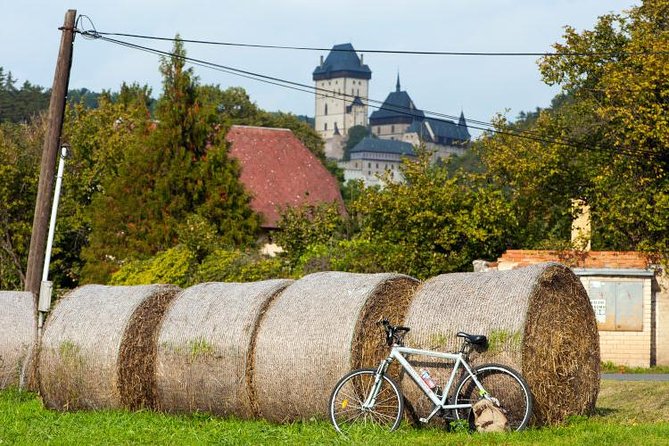
A day trip outside of Prague! Our Countryside Bike Tour rolls you southwest of Prague on the bike path along Vltava and Berounka Rivers, through the beautiful Czech countryside to the gothic Karlstejn fortress built by King Karel IV._en-US
Learn More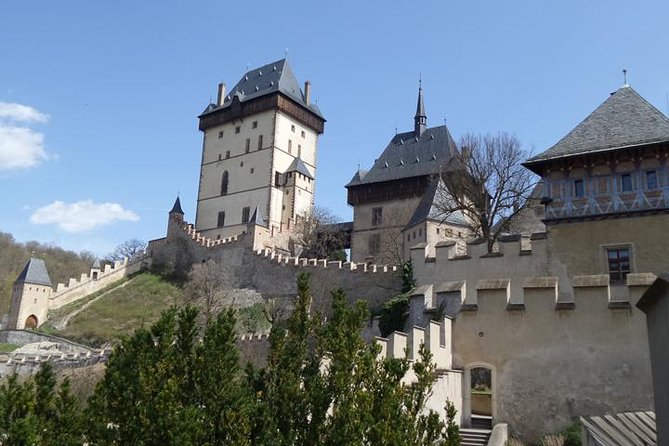
Price From
14.00 USD
Ride through the Czech countryside to Karlstejn on your E-bike. Cycle along the Vltava and Berounka Rivers. Visit the Gothic fortress of the old Karlstejn Castle during this 8-hour, guided tour._en-US
Learn More


Accessibility for wheels
- Can have severe slope, cobblestones, and/or gravel
- Bathroom: Too narrow for wheelchair
- Hilly area
- Not accessible for wheelchair and Electric scooters
- Only with assistance
- Special Parking
- Access with Portable Ramp
- Wide doors >= 75 cm and < 90 cm
- Accessible Toilet
The journey to Karlstejn Castle begins with a winding path through the lush Czech countryside. As you approach the castle, the imposing stone walls rise up before you, an ancient guardian of secrets and stories untold. The air is thick with the scent of pine trees and wildflowers, a heady mix that stirs the senses and ignites the imagination.
As you pass through the gates, the sound of gravel crunching beneath your feet echoes off the walls, a symphony of footsteps that reverberates through the centuries. The cool touch of the castle walls against your fingertips sends a shiver down your spine, a tangible connection to the past that is almost palpable.
Inside, the air is musty and thick with the weight of history. The dim light filters through stained glass windows, casting colorful patterns on the ancient stone floors. The echo of your footsteps follows you as you climb the spiral staircase, each step a testament to the countless souls who have trod this path before you.
Finally, you reach the heart of the castle, the Chapel of the Holy Cross. As you step inside, the scent of incense and candles envelops you, a fragrant embrace that fills you with a sense of peace and reverence. The flickering candlelight dances across the walls, casting shadows that seem to come alive with whispered tales of days gone by.
In the presence of the chapel’s ancient beauty, you feel a deep sense of awe and wonder, a profound connection to something greater than yourself. The intricate frescoes that cover the walls tell a story of faith and devotion, a visual symphony that speaks to the soul in a language all its own.
As you stand in the heart of Karlstejn Castle, surrounded by centuries of history and mystery, you can’t help but feel a sense of gratitude for the opportunity to walk in the footsteps of kings and queens, knights and nobles. The emotional journey of visitation to this ancient fortress leaves you with a profound sense of wonder and a renewed appreciation for the rich tapestry of human experience that stretches across time and space.
Note: Throughout the journey, the sounds of the surroundings - footsteps, whispering winds, faint echoes - are meant to evoke a sense of immersion in the atmospheric ambiance of Karlstejn Castle.
Karlstejn Castle in Prague does not provide specific information regarding the availability of audio descriptive guides or sensory-friendly hours on their official website. Visitors interested in these services should contact the castle directly for more information.
Karlstejn Castle is a breathtaking medieval fortress located about 30 kilometers southwest of Prague, perched high on a hill overlooking the surrounding countryside. This iconic castle, with its impressive Gothic architecture, has been a symbol of Czech history and culture for centuries.
Local writer Eva Nováková describes Karlstejn Castle as a place that holds a special significance for the Czech people. "Karlstejn is not just a castle, it is a symbol of our rich history and national pride. It has stood the test of time and witnessed many important events in our country’s past. Visiting Karlstejn is like stepping back in time and experiencing the grandeur and majesty of the medieval era."
Artist Jan Novotný, who has been inspired by the castle in his paintings, shares his personal connection to Karlstejn. "I have always been fascinated by the beauty and mystery of Karlstejn Castle. When I paint, I try to capture the timeless charm and romantic atmosphere of this iconic landmark. The castle has a magical quality that never fails to inspire me."
For local residents like Petra Kucera, Karlstejn Castle is not just a tourist destination, but also a place of personal significance. "I have fond memories of visiting Karlstejn with my family as a child. It was always a special day out, exploring the castle grounds and learning about its history. Even now, whenever I visit Karlstejn, I feel a sense of nostalgia and connection to my roots."
Overall, Karlstejn Castle holds a special place in the hearts of the Czech people, reflecting their deep appreciation for history, culture, and heritage. Whether you are a visitor exploring its stunning architecture or a local cherishing its significance, Karlstejn Castle continues to enchant and inspire all who have the privilege of experiencing its grandeur.
To reach Karlstejn Castle (Hrad Karlstejn) from Prague, you have several transportation options available:
1. Train: One of the most convenient ways to reach Karlstejn Castle from Prague is by taking a train from Prague’s main train station, Prague Main Station (Praha hlavní nádraží), to Karlstejn Station. The journey takes approximately 40 minutes, and the castle is a short walk from the station.
2. Bus: You can also take a bus from Prague, specifically from the Na Knížecí Bus Station, to Karlstejn. The bus journey takes about 40 minutes, and once you arrive in Karlstejn, the castle is within walking distance.
3. Driving: If you prefer driving, you can reach Karlstejn Castle by car. The castle is located approximately 30 kilometers southwest of Prague, and there are parking facilities available near the castle.
Accessibility: Karlstejn Castle is not fully accessible to those with mobility issues as it involves climbing stairs and uneven pathways. However, the lower parts of the castle with exhibits and shops are accessible.
---
When it comes to ticket bookings for Karlstejn Castle, you have the following options:
1. Online Booking: You can purchase tickets in advance through the official Karlstejn Castle website. This allows you to skip the ticket queues at the castle and secure your entry for a specific date and time slot.
2. On-Site Purchase: Tickets can also be bought at the ticket office at Karlstejn Castle upon your arrival. However, during peak tourist seasons, there may be long queues, so booking online is recommended.
Discounts: Karlstejn Castle offers discounts for children, students, seniors, and families. It’s advisable to check the castle’s official website for any ongoing promotions or special offers.
---
Local Amenities:
1. Parking: Parking facilities are available near Karlstejn Castle. There are both paid and free parking options nearby, but availability may vary depending on the season.
2. Restrooms: Restrooms are available within the castle complex for visitors.
3. Dining Options: Karlstejn offers various dining options, including cafés and restaurants serving traditional Czech cuisine. Vegetarian and vegan options are also available in some establishments.
Before visiting Karlstejn Castle, it’s recommended to check the official website for the most up-to-date information on transportation, ticketing, and amenities to ensure a smooth and enjoyable visit.