

Le Marais is a historic district in Paris, France. Long the aristocratic district of Paris, it hosts many outstanding buildings of historic and architectural importance. It spreads across parts of the 3rd and 4th arrondissements in Paris (on the Rive Droite, or Right Bank, of the Seine). Once shabby, the district has been rehabilitated and now sports trendy shopping and restaurants in streets such as Rue des Francs-Bourgeois and Rue des Rosiers. In 1240, the Order of the Temple built its fortified church just outside the walls of Paris, in the northern part of the Marais. The Temple turned this district into an attractive area, which became known as the Temple Quarter, and many religious institutions were built nearby: the des Blancs-Manteaux, de Sainte-Croix-de-la-Bretonnerie and des Carmes-Billettes convents, as well as the church of Sainte-Catherine-du-Val-des-Écoliers. During the mid-13th century, Charles I of Anjou, King of Naples and Sicily, and brother of King Louis IX of France built his residence near the current n°7 rue de Sévigné. In 1361 the King Charles V built a mansion known as the Hôtel Saint-Pol in which the Royal Court settled during his reign as well as his son's. From that time to the 17th century and especially after the Royal Square (Place Royale, current place des Vosges) was designed under King Henri IV of France in 1605, the Marais was the French nobility's favorite place of residence. French nobles built their urban mansions there—hôtels particuliers, in French—such as the Hôtel de Sens, the Hôtel de Sully, the Hôtel de Beauvais, the Hôtel Carnavalet, the Hôtel de Guénégaud and the Hôtel de Soubise, as well as many other hôtels particuliers, found all over the district. During the late 18th century, the district was no longer the most fashionable district for the nobility, yet it still kept its reputation of being an aristocratic area. By that time, only minor nobles and a few more powerful nobles, such as the Prince de Soubise, lived there. The Place des Vosges remained a place for nobles to meet. The district fell into despair after the French Revolution, and was therefore abandoned by the nobility completely, and would remain so until the present day. The Marais is now one of Paris' main localities for art galleries. Following its rehabilitation, the Marais has become a fashionable district, home to many trendy restaurants, fashion houses, and hip galleries. The Marais is also known for the Chinese community it hosts. The community began to appear during World War I. At that time, France needed workers to replace its at-war soldiers and China decided to send a few thousand of its citizens on the condition that they would not take part in the war. After the 1918 victory, some of them decided to stay in Paris, specifically living around the current rue au Maire. Today, most work in jewellery and leather-related products. The Marais' Chinese community has settled in the north of the district, particularly in the surrounding of Place de la République. Next to it, on the Rue du Temple, is the Chinese Church of Paris. Other features of the neighbourhood include the Musée Picasso, the house of Nicolas Flamel, the Musée Cognacq-Jay, and the Musée Carnavalet.

Le Marais Tours and Tickets
🎧 Available audio guides (5)
Le Marais is a historic district in Paris, France. Long the aristocratic district of Paris, it hosts many outstanding buildings of historic and architectural importance. It spreads across parts of the 3rd and 4th arrondissements in Paris (on the Rive Droite, or Right Bank, of the Seine). Once shabby, the district has been rehabilitated and now sports trendy shopping and restaurants in streets such as Rue des Francs-Bourgeois and Rue des Rosiers. In 1240, the Order of the Temple built its fortified church just outside the walls of Paris, in the northern part of the Marais. The Temple turned this district into an attractive area, which became known as the Temple Quarter, and many religious institutions were built nearby: the des Blancs-Manteaux, de Sainte-Croix-de-la-Bretonnerie and des Carmes-Billettes convents, as well as the church of Sainte-Catherine-du-Val-des-Écoliers. During the mid-13th century, Charles I of Anjou, King of Naples and Sicily, and brother of King Louis IX of France built his residence near the current n°7 rue de Sévigné. In 1361 the King Charles V built a mansion known as the Hôtel Saint-Pol in which the Royal Court settled during his reign as well as his son's. From that time to the 17th century and especially after the Royal Square (Place Royale, current place des Vosges) was designed under King Henri IV of France in 1605, the Marais was the French nobility's favorite place of residence. French nobles built their urban mansions there—hôtels particuliers, in French—such as the Hôtel de Sens, the Hôtel de Sully, the Hôtel de Beauvais, the Hôtel Carnavalet, the Hôtel de Guénégaud and the Hôtel de Soubise, as well as many other hôtels particuliers, found all over the district. During the late 18th century, the district was no longer the most fashionable district for the nobility, yet it still kept its reputation of being an aristocratic area. By that time, only minor nobles and a few more powerful nobles, such as the Prince de Soubise, lived there. The Place des Vosges remained a place for nobles to meet. The district fell into despair after the French Revolution, and was therefore abandoned by the nobility completely, and would remain so until the present day. The Marais is now one of Paris' main localities for art galleries. Following its rehabilitation, the Marais has become a fashionable district, home to many trendy restaurants, fashion houses, and hip galleries. The Marais is also known for the Chinese community it hosts. The community began to appear during World War I. At that time, France needed workers to replace its at-war soldiers and China decided to send a few thousand of its citizens on the condition that they would not take part in the war. After the 1918 victory, some of them decided to stay in Paris, specifically living around the current rue au Maire. Today, most work in jewellery and leather-related products. The Marais' Chinese community has settled in the north of the district, particularly in the surrounding of Place de la République. Next to it, on the Rue du Temple, is the Chinese Church of Paris. Other features of the neighbourhood include the Musée Picasso, the house of Nicolas Flamel, the Musée Cognacq-Jay, and the Musée Carnavalet.
Overview
More Info
- Wear comfy shoes—the district is full of cobblestone lanes and steps.
- Free Wi-Fi hotspots are located around Le Marais.
- Many shops and restaurants in Le Marais are open on Sundays, but it’s worth checking ahead.
More Adventures for You


0$
0$
3000$
Price From
4.00 USD
Le Marais is that rare neighborhood where a Jewish grandmother, a drag queen, and a natural wine sommelier might share a sidewalk. And maybe even a falafel. This is where buttery croissants meet silky cheeses, where Middle Eastern street food rubs elbows with high-end charcuterie, and where the pastries are so good you'll start looking at real estate in the neighborhood. Come hungry, come curious, and prepare to taste Paris’ diversity at its peak. Book your spot now and explore the most delicious corner of Paris with a local guide. Limited spaces available._en-US
Learn More
Price From
$61.02 USD
Join our walking tour, where a knowledgeable guide will lead you through the charming streets of Le Marais. Along the way, you’ll enjoy 11 mouth-watering tastings across 5 delicious stops, starting with fresh oysters paired with local wine to kick off your culinary adventure. Next, we’ll take you to Paris' oldest covered market, a lively, historic spot where you’ll taste artisanal cheeses, local confiture, and fine wine while your guide shares fascinating stories about the market and its history. Next, a delicious street food experience. Get ready to taste crispy, flavorful falafel, a Middle Eastern favorite that has become a must-try in Paris. Then, enjoy a cozy 2-course sit-down dinner at a traditional French bistro, where you’ll savor Onion Soup and Boeuf Bourguignon, two classic dishes that embody the heart of French cuisine. We’ll wrap up with a sweet treat—watch as your freshly prepared crêpe comes to life before your eyes, the perfect way to end a delicious day in Le Marais._en-US
Learn More
Price From
$21.44 USD
Discover Paris in a whole new way with our eclectic and entertaining guided walking tours, each offering a unique perspective on the city’s rich culture and history. Whether you’re drawn to the historic charm of the Latin Quarter, the bohemian spirit of Montmartre, or the elegant streets of Le Marais, there’s a tour to match your curiosity. Art lovers can dive into the city’s vibrant urban scene with two street art tours led by a local artist. If you’re a fan of Emily, step into her world and see Paris through her eyes, or let a real Cancan dancer guide you through Montmartre’s hidden alleys. With each tour offering an engaging, immersive experience, the hardest part is choosing where to begin!_en-US
Learn More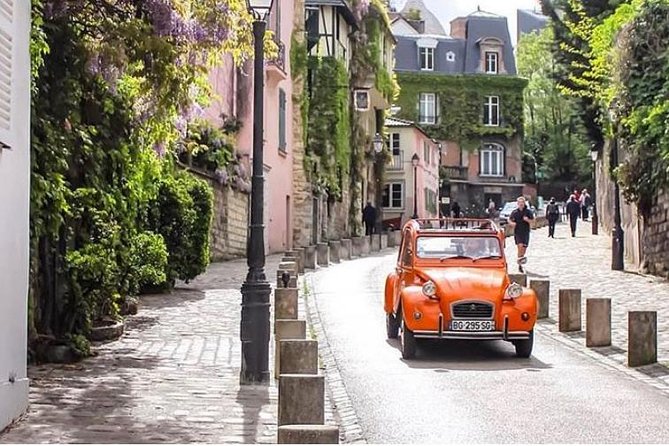
Price From
$398.53 USD
This 3-hour 2CV tour is ideal for discovering the city and discovering the great Parisian monuments but also unsuspected neighborhoods and secret places, including those of Parisians themselves. During the tour, you will enjoy the anecdotes of driver guides who will meet all your expectations. Very beautiful photos are taken during the tour to immortalize this moment. Note: The visit of all the monuments listed is not guaranteed due to traffic, weather and other events in Paris._en-US
Learn More

For Individuals with Hearing Loss
- Hearing kits
- Speech To Text
Access for Seniors
- Access with Portable Ramp
- Recommended time for visit 1 hour
- Recommended time for visit 2 hours
- Physical difficulty level - 3
Accessibility for wheels
- Access with Portable Ramp
- Can have severe slope, cobblestones, and/or gravel
- Bathroom: Too narrow for wheelchair
- Wide doors >= 75 cm and < 90 cm
- Exhibit height - 3
Access for Visually Impaired
- Audio Guide
- Place has Special Guide Service
- Service animals permitted
Paris… mais pas n'importe quel Paris. On va se plonger dans Le Marais. Imagine. Le sol change sous tes pieds, le pavé devient la mémoire de centaines d'années de pas. C'est une texture rugueuse, parfois inégale, qui te connecte instantanément à l'histoire. Tu sens l'air, plus dense ici, saturé d'une douce odeur de pain chaud qui s'échappe d'une boulangerie lointaine, mêlée à l'humidité des vieux murs de pierre. Tu entends un murmure constant : des rires lointains, le cliquetis d'une tasse sur une soucoupe dans un café invisible, le froissement d'un sac de courses. C'est une sensation d'être enveloppé, de ralentir, comme si le temps lui-même prenait une profonde inspiration et s'étirait.
Puis, le son d'un accordéon qui semble surgir d'un autre temps, se mêlant à l'effervescence des voix. Il y a l'épice du falafel qui te saisit, une vague chaude et invitante qui te guide presque par le nez. Tu marches, tu tournes, et soudain le soleil réchauffe une façade ancienne, sa pierre dorée te rendant la chaleur. Ou alors, la fraîcheur d'une cour intérieure cachée t'enveloppe, un havre de paix où le bruit de la ville s'estompe pour laisser place au chant des oiseaux. Tu sens le rythme de la ville te pénétrer, une douce mélodie de vie parisienne qui s'installe en toi, une impression de familiarité, comme si tu avais toujours appartenu à ces rues. Ce sentiment reste longtemps après que tu aies quitté le quartier.
Bon, parlons bouffe. Le Marais, c'est le royaume du falafel. Sérieux, tu ne peux pas passer à côté de l'As du Fallafel ou de Mi-Va-Mi. C'est rapide, pas cher et juste divin. Mais ne t'arrête pas là. Cherche les petites boulangeries pour une vraie baguette ou un croissant croustillant, et les cafés pour un chocolat chaud épais qui te réconforte. Il y a aussi plein de petites épiceries fines si tu veux ramener un truc spécial, ou des fromageries pour un plateau improvisé.
Après ça, prévois du temps pour flâner. Oublie la carte un instant. C'est là que tu vas trouver les boutiques indépendantes incroyables, les galeries d'art minuscules avec des pépites uniques. La Place des Vosges, c'est un incontournable pour se poser et juste observer le monde passer. Et les petites rues comme la Rue des Rosiers ou la Rue Vieille du Temple, elles sont pleines de surprises. N'hésite pas à t'engouffrer dans les passages, c'est souvent là que se cachent les plus belles cours intérieures, des havres de paix insoupçonnés.
Pour venir, le métro est ton meilleur ami : Saint-Paul, Hôtel de Ville ou Chemin Vert, ça dépend où tu veux commencer ta balade. Mais surtout, mets des bonnes chaussures ! Tu vas marcher, beaucoup marcher, sur des pavés parfois inégaux. Le Marais se découvre à pied, en prenant son temps. Évite le week-end si tu n'aimes pas les foules, surtout l'après-midi. Le matin en semaine, c'est magique, plus calme, plus authentique, et tu peux vraiment t'imprégner de l'ambiance.
Léa from the road
Le Marais… Imagine l'odeur du vieux calcaire mêlée à celle des croissants tout juste sortis du four. Tu entends le murmure lointain des conversations, le tintement des verres depuis une terrasse de café cachée. Tu sens l'air frais dans les passages étroits. C'est un quartier qui murmure des histoires de siècles passés, où chaque coin recèle un secret. La lumière y filtre différemment, peignant les murs anciens de nuances dorées et grises. C'est une étreinte, un doux bourdonnement qui t'invite à ralentir et à vraiment *être* là.
Maintenant, parlons de la mobilité. Imagine-toi en train de rouler sur ces vieux pavés parisiens. Tu sentiras chacun d'eux, un roulement et une vibration constants à travers tes mains et ton corps. Ce n'est pas une balade fluide, loin de là. Certaines rues sont meilleures, plus plates, mais beaucoup de ces charmantes ruelles sinueuses sont un véritable défi. Et les pentes ? Le Marais n'est pas plat. Tu rencontreras des inclinaisons douces et quelques rampes plus raides, surtout autour de la Place des Vosges ou en direction de la Seine. Cela demande un effort, une poussée continue.
La largeur des rues peut être délicate. Certaines artères principales sont suffisamment larges, mais beaucoup des rues les plus atmosphériques sont assez étroites. Imagine essayer de naviguer dans une rue animée où les tables débordent sur le trottoir et les piétons surgissent de toutes parts. Aux heures de pointe, comme les après-midis de week-end, cela peut ressembler à une rivière humaine, et trouver de l'espace peut être une vraie lutte. Les gens sont généralement corrects, mais souvent inattentifs. Tu en trouveras qui s'écartent, d'autres qui ne remarquent rien, et quelques-uns qui pourraient même bloquer le passage. La patience est essentielle.
Alors, est-ce gérable ? Avec beaucoup de planification et une bonne dose de résilience, oui, ça peut l'être. Ce n'est pas ce que j'appellerais "accessible en fauteuil roulant" au sens moderne du terme, mais ce n'est certainement pas impossible. Mon conseil ? Vas-y tôt le matin, surtout le week-end, pour éviter la foule. Reste autant que possible dans les rues plus larges, comme la Rue des Francs Bourgeois ou les sections principales de la Rue de Rivoli si tu as besoin d'un tronçon plus lisse. Envisage d'utiliser un transport spécialisé si tu viens de plus loin, car le métro peut être un cauchemar. Et n'hésite pas à demander de l'aide ; les Parisiens, malgré leur réputation, peuvent être étonnamment serviables si on les approche gentiment.
Clara de Paris
Imagine le Marais qui s'éveille, pas encore bruyant, juste un murmure. Tu marches sur les pavés, encore frais de la nuit. Ce n'est pas l'odeur du croissant chaud qui domine, pas tout de suite. C'est plus profond. C'est l'odeur minérale et terreuse des vieilles pierres des immeubles, qui ont gardé l'humidité de l'aube et la libèrent doucement, se mêlant à peine à la première, très lointaine, pointe de levure d'une boulangerie qui commence à pétrir. Il faut presque tendre le nez pour la capter. Et tu entends un son très spécifique : pas les voitures, pas encore les bavardages, mais le léger frottement d'un balai, puis le doux clapotis de l'eau sur le trottoir. Un commerçant nettoie son bout de rue, un rituel discret, une sorte de respiration avant que la vie ne s'emballe. Tu sens cette fraîcheur matinale qui te fait resserrer un peu ta veste.
Pour vraiment t'imprégner de ce moment suspendu, essaie d'être dans le Marais vers 7h00-7h30 du matin. Ne te dirige pas vers les grandes artères. Préfére les rues plus calmes comme la Rue des Archives ou la Rue du Parc Royal. Beaucoup de boutiques et de cafés seront encore fermés, mais tu trouveras quelques boulangeries déjà ouvertes, leurs lumières allumées, avec quelques locaux qui attendent leur café fumant et leur pain au chocolat. Prends le tien, trouve un banc tranquille dans une petite place (même si la Place des Vosges se remplit vite, ses recoins sont magiques tôt le matin), et contente-toi d'être là. C'est le moment idéal pour une réflexion silencieuse avant que le bourdonnement de la ville ne reprenne ses droits.
Léa de la route
Si tu dois t'immerger dans un quartier parisien, commence par Le Marais. Imagine-toi sortir du métro Saint-Paul, et d'un coup, le bruit de la ville s'estompe. Tu sens déjà l'air changer, plus dense, chargé d'histoires. Tes pieds rencontrent un pavé irrégulier, chaque pas résonne différemment. L'odeur du pain chaud commence à te chatouiller les narines, mélangée à une pointe d'épices inconnues. Tu entends un brouhaha lointain qui t'attire, un mélange de rires, de conversations et du cliquetis de vaisselle. C'est le Marais qui t'appelle, et on va le découvrir ensemble, pas à pas.
Laisse-toi guider par cette symphonie olfactive jusqu'à la Rue des Rosiers. Là, l'odeur du falafel est partout, enveloppante et irrésistible. Tu peux presque sentir la chaleur des pois chiches frits, le croquant de la salade fraîche. Le son des commandes passées en plusieurs langues se mêle au murmure des passants, créant une ambiance joyeuse et chaotique. Si tu dois goûter à l'âme du quartier, attrape un falafel à emporter – celui de l'As du Fallafel est une institution, mais la file d'attente peut être longue. Honnêtement, si tu es pressé, n'importe lequel fera l'affaire, l'expérience est là.
Puis, quitte l'agitation et tourne dans une des petites rues adjacentes, comme la Rue des Écouffes ou la Rue du Roi de Sicile. Tu sentiras immédiatement la fraîcheur de la pierre ancienne contre tes mains si tu les laisses glisser le long des murs. Le silence revient, presque palpable, brisé seulement par le léger frottement de tes pas sur le pavé. Tu pourrais presque entendre l'écho des siècles passés. Lève la tête, ou plutôt, imagine la hauteur des immeubles, la façon dont ils encadrent le ciel, révélant parfois la surprise d'une cour intérieure cachée, un havre de paix insoupçonné.
Continue ton chemin vers la Rue des Francs Bourgeois. Ici, l'ambiance change à nouveau. Les boutiques de créateurs et les galeries d'art remplacent les échoppes traditionnelles. Tu pourrais sentir la texture douce et luxueuse d'un tissu à travers une vitrine, ou la brise légère qui apporte avec elle le parfum d'une bougie artisanale. C'est le moment de flâner. Tu trouveras des boutiques uniques, des librairies indépendantes. Pas besoin de tout acheter, juste d'absorber l'atmosphère. Ce que je te conseille de *sauter*, ce sont les chaînes de magasins que tu trouves partout ailleurs ; concentre-toi sur l'originalité du Marais.
Enfin, laisse-toi porter jusqu'à la Place des Vosges. C'est un peu comme si le Marais te dévoilait son secret le mieux gardé. L'espace s'ouvre soudainement, immense et symétrique. Tu peux sentir l'herbe fraîche sous tes pieds si tu t'aventures au centre, et la chaleur du soleil sur ton visage. Le bruit des fontaines est apaisant, un doux murmure qui invite à la contemplation. C'est l'endroit parfait pour t'asseoir sur un banc, sentir la pierre chauffée par le soleil et simplement écouter le vent jouer dans les feuilles des arbres. C'est ça que je te recommanderais de *garder pour la fin* : ce moment de sérénité absolue, une ancre après la douce effervescence du quartier.
Olya from the backstreets
Imagine que tu t'engages dans une rue étroite, comme si le temps lui-même avait ralenti son pas. Le Marais, à Paris, ce n'est pas juste un quartier, c'est une sensation. Tu marches sur des pavés anciens, irréguliers, qui te racontent des siècles d'histoires sous tes pieds. L'air est différent ici ; il est plus doux, imprégné d'une odeur subtile de vieilles pierres humides, de café fraîchement moulu et, parfois, d'une pointe d'épices venues des restaurants lointains. Tu entends un murmure continu, un mélange de rires étouffés derrière des façades discrètes, le cliquetis lointain de tasses et de soucoupes, et le son feutré des pas sur le bitume, contrastant avec le crissement des graviers dans les cours intérieures.
Tu passes une main sur le mur frais d'un hôtel particulier, sentant la texture rugueuse de la pierre, puis le contact lisse d'un bois ancien sur une porte cochère. Le soleil joue à cache-cache, projetant des éclats de lumière chaude sur les façades, puis plongeant les ruelles dans une ombre rafraîchissante. Tu perçois l'intimité des lieux, comme si chaque recoin était un secret bien gardé. Soudain, tu es happé par une odeur plus forte, irrésistible : celle du falafel, chaud, croustillant, qui te guide vers une file d'attente animée. Tu sens la vibration de la vie parisienne, authentique, juste là, sous tes doigts, dans l'air que tu respires.
Quand la faim se fait sentir après toutes ces explorations sensorielles, ou quand tu as besoin de te repérer, voici quelques tuyaux pratiques pour profiter au mieux du Marais :
* Le meilleur moment pour y aller : Le matin, en semaine, est parfait pour sentir l'âme du quartier avant l'agitation. Les boutiques ouvrent, les cafés s'animent doucement. En fin d'après-midi, l'ambiance devient plus festive et les lumières sont magnifiques.
* Pour éviter la foule : Absolument, évite les week-ends, surtout l'après-midi. C'est bondé, et l'expérience sensorielle est moins intime. Privilégie le mardi, mercredi ou jeudi matin.
* Combien de temps y passer : Prévois au moins une demi-journée pour flâner sans stress. Si tu veux visiter des musées (Musée Carnavalet, Musée Picasso) ou vraiment te perdre dans les ruelles, une journée entière est idéale.
* Ce que tu pourrais zapper : Si ton temps est limité, tu n'es pas obligé de faire toutes les boutiques de souvenirs qui se ressemblent. Concentre-toi sur les artisans locaux, les galeries d'art ou les librairies indépendantes pour une expérience plus authentique. Et si les musées ne sont pas ta tasse de thé, ne te force pas, le quartier en lui-même est un musée à ciel ouvert.
* Quelques astuces locales :
* Cafés : Cherche les petits cafés indépendants comme le Boot Café (minuscule, mais adorable) ou Fragments. Ils ont souvent un charme fou et un excellent café.
* Toilettes : C'est la galère à Paris ! Le plus simple est d'utiliser celles des musées ou de t'arrêter dans un café pour consommer et demander l'accès. Il y a quelques toilettes publiques automatiques (Sanisettes), mais elles ne sont pas partout.
* Falafel : Ne manque pas un falafel rue des Rosiers ! L'As du Fallafel est le plus célèbre, mais les autres sont très bien aussi. Prépare-toi à faire la queue, mais ça vaut le coup.
* Découvertes : N'hésite pas à t'aventurer dans les passages et les cours intérieures, beaucoup sont ouverts au public et révèlent des trésors cachés de calme et de verdure.
Olya des ruelles